When we think about moving more, we often picture an exercise class, a long run or an hour we do not have. But there is another, quieter question worth asking: where could a little movement fit between the things we already do?
This is not a plan for doing more at every opportunity. It is a way of noticing the shape of your day, finding a few moments of variety and choosing something that feels manageable. There is no single routine that needs to suit everyone.
Start with the day you already have
A busy day can become a sequence of seats: breakfast, the journey to work, a desk, then the sofa. It is easy to reach the evening and realise that you have barely changed position. That is an observation, not a failure. Work, caring responsibilities, travel and tiredness all shape the space available to us.
Before adding another task to your list, look for the transitions already there. Finishing a call, putting the kettle on or closing a document can be an invitation to move a little. You might walk to the window, get a glass of water or spend a moment standing before the next task. The point is not to turn every pause into exercise. It is to make a little room within the day you actually have.
Let a walk be a walk
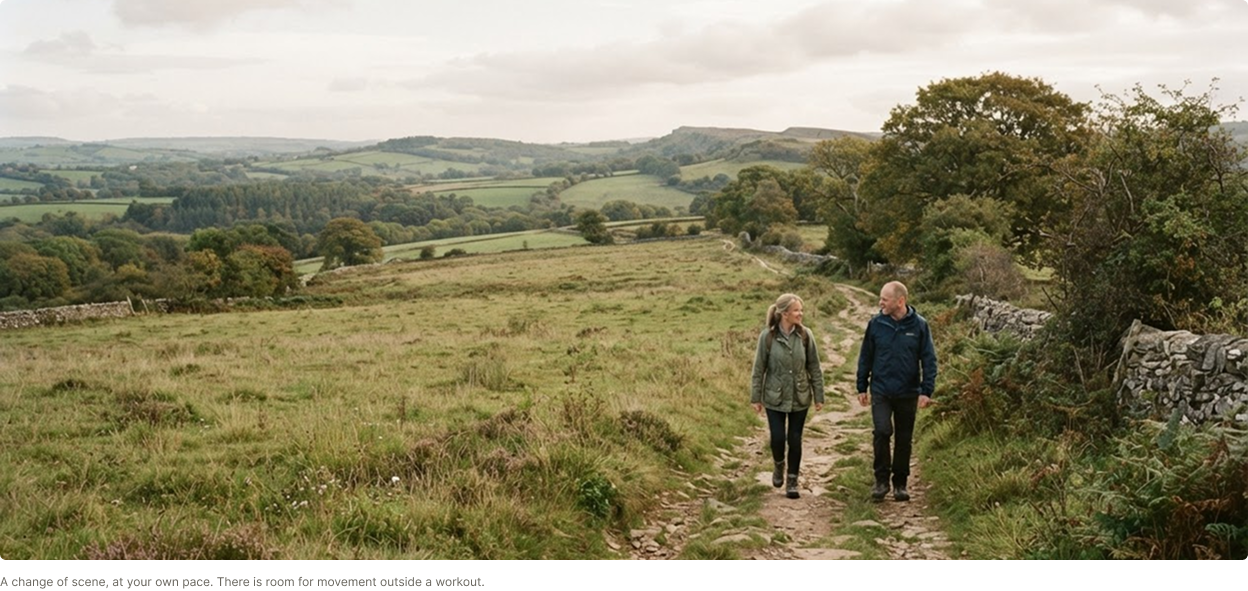
Walking does not need a special route, a target pace or a record on your phone to count as movement. A short loop near home, a trip to the local shop or a wander during a lunch break can each have a place. Choose somewhere you feel comfortable and a length that suits your energy, your surroundings and the time available.
If you are used to measuring everything, try leaving the numbers out of one walk. Notice the light, the sounds or the feeling of being somewhere other than your desk. Walking with someone can make it social; walking alone can leave space for quiet. Neither version needs to be productive. If walking is not accessible to you, a change of setting or some comfortable seated movement can be another way to interrupt a long stretch in one position.
Change position, not chase perfection
At a desk, it is tempting to search for the one correct way to sit and then hold it all day. A more practical starting point is to notice when you have stayed still for a long time. You might adjust your chair, let your feet rest somewhere supported or move a frequently used item within easy reach. Aim for a setup that works for the task, rather than a pose to maintain.
Changing position could mean standing for part of a call, walking to speak to a colleague or sitting somewhere different to read. It could also be as simple as shifting how you sit. Standing is an option, not an obligation or a replacement position to hold indefinitely. Let comfort, access and the work in front of you guide the choice. If a movement brings on pain or makes symptoms worse, stop rather than pushing through it.
Make the next choice an easy one
Good intentions can disappear under a full inbox. Rather than building an elaborate routine, choose one familiar cue and one small action. After lunch, you might take a short walk before opening your messages. When a meeting ends, you might stand and move around the room before joining the next one. Pick something specific enough to remember and modest enough to feel possible on an ordinary day.
Practical details matter. Keep shoes where you can find them, choose a route with a shorter option or leave a small gap between appointments where you can. A reminder can help if it feels useful, but it does not have to become another demand. On a crowded day, your version may be smaller than you planned. That is a reason to adapt the idea, not abandon it or make up for it later.
A small thing to try
One cue. One comfortable change.
Choose a pause that already happens in your day. Pair it with a brief walk, a change of position or a little seated movement. Try it tomorrow, then notice whether it fits. Keep it, adjust it or choose a different moment.
For example: “After I finish lunch, I’ll take a short loop outside before I return to my desk.”
Leave room for real life
Some days offer a long walk and an unhurried lunch. Others are shaped by deadlines, poor weather or caring for someone else. Movement does not have to look the same in both. Rest has a place too, and a day that includes less movement does not need to become a judgement about your effort.
At the end of the day, ask a gentler question than “Did I do enough?” Was there a moment when you could change position, step outside or pause between tasks? If something worked, make it easy to repeat. If it did not, start smaller. Making room for movement can begin with one ordinary moment, without turning the rest of your life upside down.